
Why Owners are Rethinking Project Asset Data in the Age of AI
| Owners need better project asset data to support handover, operations and AI, plus how facility condition assessments and asset-centric methods can reduce delays, missing records and post-closeout |
The government has a huge responsibility when it comes to infrastructure, big projects and public service delivery.
“Everybody has a piece of paper, everybody has a spreadsheet, everybody kind of does their own thing. And hopefully, everybody has a meeting and keeps the trains on time.”
So said Kurt Wood, senior fellow at Seneca Government and former CIO and cabinet secretary for the Commonwealth of Massachusetts.
That approach might get a project through design and construction, but it doesn't help the teams who operate and maintain the facility or asset after completion.
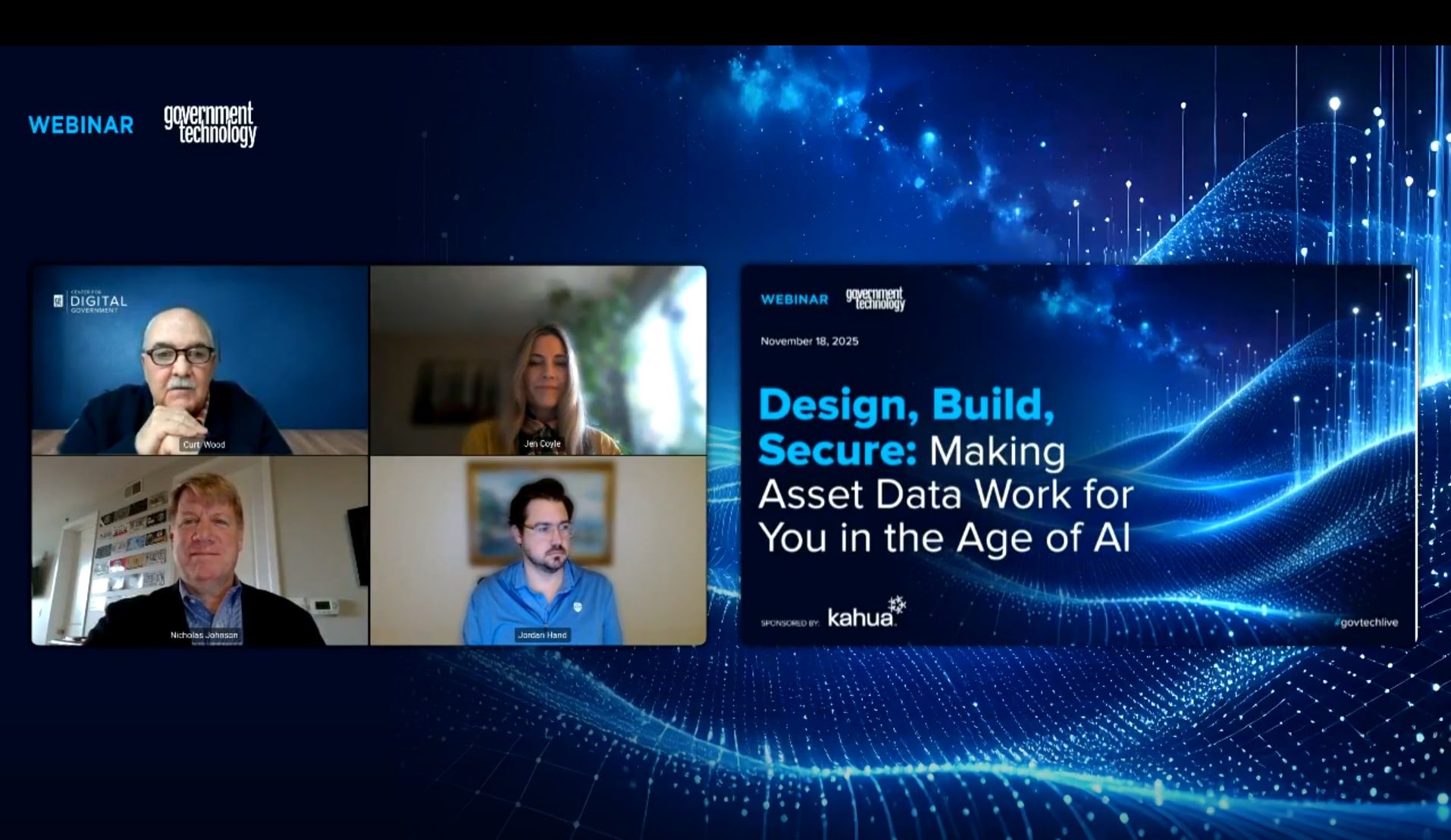
In Kahua’s recent GovTech webinar, Making asset data work in the age of AI, Wood joined Kahua’s chief evangelist Nicholas Johnson, customer success manager Jen Coyle, and solutions director Jordan Hand, to discuss: Why are owners putting more pressure on project teams to deliver usable asset data? How does that affect handover?
And speaking of hot topics, where does AI fit in?
The handover problem doesn’t stop at closeout
Project teams are trained to deliver the project on time, on budget, with quality and safety. But it’s operations teams who inherit the long tail of maintenance, service life and replacement, for years and decades after construction is done.
When these two groups are misaligned, problems show up with handover.
Owners need quick access to basic information: warranties, operating manuals, model numbers, inspection history and installation records, but it’s generally not in a form teams can actually use.
“The documents that most likely nobody ever really reads until there’s an emergency,” said Wood. “They don’t even know where it is. It could be in a file drawer somewhere.”
“It’s not paper anymore,” Johnson said, “but it might as well be. It’s 100,000 PDFs and 1000 spreadsheets on a thumb drive.”
He shared a striking example from our customer, a world-renouned research and medical center.
“Our client did a self audit of the information they were supposed to be provided at the end of a project, information that they needed to operate their new facility.
And the audit indicated that they only received 40% of what contract said they should have got.”
That kind of gap creates cost, delay and risk long after the project team has moved on.
The medical center only received 40% of the asset information their contract said they should have got.
Owners need a full view of the asset, not just a finished project
“Within those organizations, multiple stakeholders need to make sure they have the data,” said Wood. “You've got the maintenance group, the procurement group, the budget folks. You might have to punch out reports for the legislature, for the governor, for the mayor.
“Having that full view of the asset and the data that goes with it is critical.”
That becomes more realistic when owners define which assets matter, which fields they need to collect, and how teams should gather that information during the project rather than after it.
“Data collection is a key reason for our Asset Centric Project Management (ACPM) methodology,” said Coyle.
“Kahua is a full lifecycle construction project management system, but it also includes the ability to capture asset data.
“In Kahua, the asset is more central to the construction process,” Coyle said. “This allows for continuous handover, so organizations are ready for operations on day one—not spending months or years organizing all of that asset data in their system.”
AI can help with FCAs, but only with quality data
Data capture is one place AI is already in use today.
Using Kahua, users can scan a nameplate on a piece of equipment and use AI to pull in attributes such as serial number, model number and other details automatically, while still keeping a person in the loop to verify the information.
“AI is wonderful, it’s powerful. It’s here to stay,” said Johnson. “It’s going to change the way we do a lot of things. But a lot of AI point solutions are being developed. Just to make sure that you know what’s happening with your data.”
Asset data can include sensitive information about systems, locations and operations, and owners need to know where that data is going and how it is being used.
AI works best when the underlying data is structured, complete, and tied to the right asset. If the data is scattered across spreadsheets and attachments, or stored in inconsistent formats, there’s less context for AI to leverage and less reason to trust the result.
If the data is scattered across spreadsheets and attachments, there’s less context for AI to leverage, and less reason to trust the result.
“Our recommendation is: Trust your vendors,” said Johnson. “Ask a lot of questions.”
Start AI-assisted FCAs with existing assets
For older buildings and facilities, treat facility condition assessments as a starting point. It's table stakes to collect asset data for a brand-new building so it’s ready for operations on day one. But most buildings are older.
So how can you leverage AI for your FCA across your existing portfolio?
“The facility condition assessment offers an opportunity to go collect all the data that you did not collect properly when you were building that building,” Johnson said. “For projects going forward, just start with one and see how well this works.”
If you’re using Kahua, Hand said, “you can see the data pulled in with submittals: I have the information about my boiler. I have the attached O&M. I have the warranty data.
“Since it’s tagged to the appropriate asset, it is simply a matter of updating the asset and the system will automatically connect the data in from the submittals and other records in the system back to the asset. And if I’m out at a location of one of our facilities or buildings on a mobile device, I can use my phone or tablet or computer.”
Instead of waiting until closeout to gather manuals, warranties, model numbers and maintenance records, start connecting that information to the asset throughout the process.
ACPM gives owners a more structured way to carry asset data from design and construction into handover and operations, so your teams don't have to rebuild the record after the project is done.
For older facilities, the FCA is a great place to start (and consider how AI can help). Kahua’s AI-enabled ACPM solution connects that information to the asset through design, construction, and handover.
You already know the cost of waiting until the end to sort it all out.