Solving for Different Contract Types in Your Project Management Software
|
Construction contracts vary by project length, task variability, compliance needs, owner oversight, and more. Non-traditional contracts can speed procurement but may require support for organizational and tech overhauls. |
Every owner wants to start projects and the contracting strategy thoughtfully; thinking through all potential contingencies.
Each project has its own unique risks and decisions. What happens if I put all my eggs in one contract and it fails? What if linking my major materials means I can’t order it early enough to arrive?
The structure of your contract will dictate how your team reacts, ultimately shaping cost-control strategies, communication, transparency, and stakeholder alignment on outcomes.
By exploring the alternative types of construction contracts we cover in this article, you’ll be ready to negotiate an agreement that has the flexibility your projects require.
Overview of Construction Contracts and Procurement Strategies
Most major construction project service internal and external staff in three work areas; administration and project services, design and construction. Depending on the delivery type this could be three or more contracts issued to complete services.
The contract vehicle or procurement strategy further extends into “how” the services are procured. Project specific procurements and contracts can apply to one-time discreet projects while an Owner that has a massive infrastructure and construction portfolio tends to look for efficiencies in procuring external parties.
| Category | When It's Used | Key Benefit |
|
Contract Compensation |
Different compensation methods help to pass risk or encourage shared benefits between the Owner, Consultant and/or Contractor | While hard dollar bids (traditional) tended to be the norm for many years, new compensation strategies encourage shared benefits and outcomes. |
| Delivery Type |
Traditional Design-Bid-Build (DBB) doesn’t always work for all projects. For projects where the delivery method itself (design-build, CM, IPD) matters alternative delivery methods provide more options and stronger teaming perspectives. |
Better integration between design, construction, and delivery phases. Distributed interest and risk. |
|
Task Order Based, On-Call / IDIQ Contracts |
For efficiency of procurement processes, aligning multiple projects to a higher level procurement brings longer term relationships. | Speed, flexibility, and streamlined procurement of task orders after initial contract setup. Repeated relationships distributes risk across a portfolio. |
Project level bespoke procurements can take six to nine months.
This is a significant delay when many construction projects are seeking aggressive ROI and a day delayed can equal direct loss of profits or services.
While both project level traditional delivery and alternative delivery were more common historically, many agencies are expanding on-call (or Infinite Delivery, Infinite Quantity (IDIQ) naming used more commonly in the federal space) and task orders to move procurement qualifications earlier in the process.
Once scope is more known, specific task orders are issued on the design or construction side to expedite procurements, bringing them to a month or less.
Contract Compensation
Because design and construction is inherit risk to both the Owner and the Contractor, determining who bears the risk is a major factor in determining different fee/payment structures and delivery types.
Procurement of design and construction services can be intertwined or separate. Let’s explore some common ones. Once a project team determines scope and complexity of the project. They may use one or more procurement strategies to make up their services.
Lump-Sum (Fixed Price)
Companies enter into lump-sum, also known as fixed-price, contracts when both parties agree on a single price for the completed project.
Whether the actual cost of the work and materials exceeds or falls short of the fixed price doesn’t affect the final price paid. These contracts prioritize clarity, but are inflexible.
- Use cases: A lump-sum contract is best suited for well-known, consistent projects with a low risk of delays and regular material costs.
- Pros: Clarity, administrative ease, and budgeting ease.
- Cons: Doesn’t account for cost or scope changes, may pressure the contractor to use inferior methods or materials to increase margins.
Time and Materials (T&M)
While all contract types can have a mix of line items with T&M or lump sum, contracts tend to favor one over the other. Time and materials contracts require the owner to pay the contractor for actual labor time and materials used. In this case, contractors report detailed labor and materials logs. These contracts may include a maximum price agreement.
- Use cases: When the project scope, labor costs, or material pricing is uncertain or subject to change.
- Pros: Allows for flexibility in changing markets, logs show granular changes to scope and pricing.
- Cons: Requires detailed logging and monitoring, high level of trust between the owner and contractor is required.
Cost Plus
In cost plus contracts, both parties agree on a standard fee added to the contractor’s costs. The two parties must agree on the terms within this contract as to acceptable costs.
- Use cases: Projects with unknown scope or unpredictable conditions
- Pros: Flexible and built for unknown unknowns, less pressure to increase margins.
- Cons: Requires significant trust between the owner and contractor not to add unnecessary materials or labor costs.
Unit Price
Unit price contracts agree upon a set price for all labor, materials, and work within a unit. The unit can be measured in miles of paved road, feet of buried cable, or utility poles replaced.
- Use cases: Often used in highway construction and utilities, these contracts are best for jobs where the total number of units may be uncertain, but the work per unit is certain.
- Pros: Flexible, good for estimating within uncertain projects.
- Cons: Requires careful records and may be prone to high costs due to misestimation.
Delivery and Risk Transfer
Construction contracts can have varying payment structures. These are decided early on and linked to the project delivery type. The main varying factors in this is when the contractor is engaged in relation to scope and design, who assumes risk and how different parties are incentivized as part of delivery.
Design-Bid-Build (Traditional Delivery)
The method most familiar to folks is a traditional design-bid-build (DBB). With this method, consulting firm or designer brings the scope or design to a 90%+ level and issues drawing for bid or construction (IFB/IFC). The Contractor bids a hard dollar estimate based on a high level of confidence that the design is relatively fixed.
- Use cases: Design-bid-build (DBB) is good for clear scope definition prior to bid.
- Pros: Efforts up front reduce risk for construction costs.
- Cons: Lowest cost and later Contractor engagement.
Design-Build
Design-Build starts to bring in the Contractor earlier in to provide final design services. This contract tends to be initiated around 30% design, depending on the scope and complexity of the project. Because the Contractor is influencing design, they tend to bring in strategic direction and efforts on reducing overall project costs.
Design build project contracts combine both the design and build portions of the project. Under traditional contracts, the architect or designer contracts separately from the construction company, which may be more competitive on pricing but can lead to communication issues and work delays.
With design-build projects, construction companies work directly with architecture and engineering firms, directing the design-build project management lifecycle while reporting to the owner.
- Use cases: Design build contracts are best for expansive projects with complicated plans that require tight cooperation and communication.
- Pros: Fewer communication issues and delays, more predictable budgeting.
- Cons: Less vendor competition may drive up pricing, requires communication skills, and technology.
Construction Management (CMa and CMAR)
Construction management contracts include CMa (construction management as advisor/agent) and CMAR (construction manager at risk).
A CMa contract allows the owner to hold contracts with individual contractors while the construction management team advises on the work with those contractors.
CMAR puts the construction manager as the owner of the subcontracts. These types of contracts centralize control either at the owner's or the construction manager's level.
- Use cases: Projects where tight control of subcontracts and outcomes is necessary, usually smaller or public projects. CMa contracts also give owners more input into design, while CMAR gives construction managers tighter budget controls.
- Pros: Centralized responsibility and oversight, possibly better budget adherence.
- Cons: Significant work for the responsible party to manage all subcontractors.
Integrated Project Delivery (IPD)
Integrated project delivery contracts put both design and construction under a single agreement, like design build contracts. Still, everyone signs a multi-party contract rather than tasking the construction team with finding a design and engineering partner.
- Use cases: Projects with high transparency needs and clear communication.
- Pros: Distributes risk among the partners as all sign the contract and work collaboratively for project success.
- Cons: Requires high levels of transparency, may be slowed by disagreements.
Task Order-Based, On-Call / IDIQ Contracting
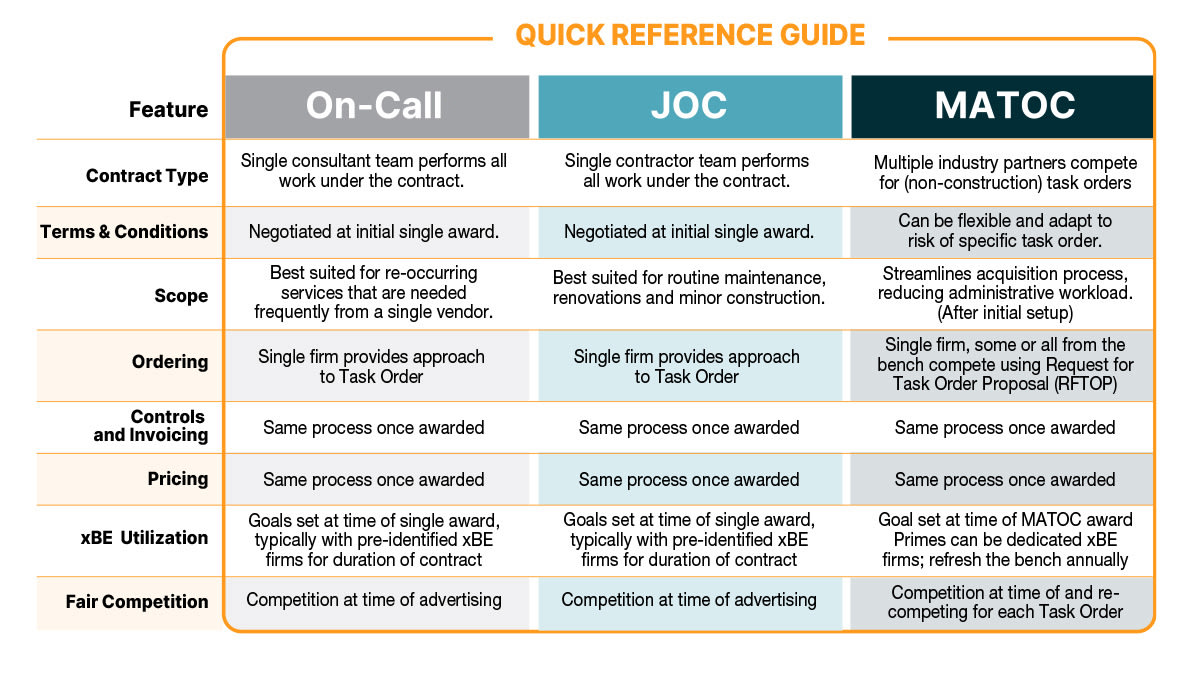
All of the delivery types are enabled by the use of multiple year / multiple task order type approaches.
When a public or private owner has a large portfolio, many times condensing vendor pre-qualification and investing in long term relationships with their potential professional service, design and construction contractor bench reaps better results across all projects.
IDIQ is a more common phrasing in the Federal space that recognizes different types. On-Call by this measure is a type of IDIQ contract. State and local governments increasingly use different types of IDIQ contracts to accelerate procurement for ongoing or repeatable work, such as environmental, design, project management, and construction management.
Because a large concern of multiple year contracts reduce market competition, IDIQ contracts also maintain federal and state requirements while enabling fair competition and valuable efficiencies.
IDIQ, JOC, and MATOC contract types repeat the same process for controls, invoicing, and pricing once they’re awarded. By simplifying the procurement process, they streamline efforts and bring better competition from a diverse contractor bench.
Work that traditionally delayed procurements becomes front-end work that eliminates the time spent on individual custom procurement processes for each project.
Master Service Agreements (MSA)
Master Agreements are multiple year agreements that focus more on establishing terms and conditions of executing the work. They are suited well after vendor pre-qualification that may or may not establish a rate sheet while allowing flexibility for scope of services, compensation types and unique project needs.
They save some time in the procurement process by eliminating task-specific contract negotiations. They tend not to have dollar limitations or offer a promise of minimum work to a Consultant.
- Use cases: Establish terms and conditions under which services are governed.
- Pros: Eliminate legal negotiations per task or project.
- Cons: No established promise of work or relationships.
On-Call Contracts
On-call contracts are a simple form of IDIQ used for repeatable services, in which a single consultant team performs all work under the contract. These contracts typically limit total service dollars across one or more contracted entities.
Best suited for frequently-needed, recurring services from a single vendor, these contracts are repeatable and provide competition at the time of advertising. State and local governments increasingly use IDIQ contracts to speed up procurement for ongoing or repeatable work.
- Use cases: Recurring services frequently needed from a single vendor.
- Pros: Faster procurement, repeatable processes.
- Cons: Less flexible than JOC or MATOC.
Job Order Contracting (JOC)
Job order contracts are a form of IDIQ that contracts with a single vendor and establishes a unit-price book for services.
Commonly used by governments for tasks like repair, renovation, or construction management, JOC works best when contracting with a single vendor for ongoing, repeatable work.
The set pricing, long-term contract, and agreed-upon services mean the companies have a standardized, templated process that delivers significant administrative efficiencies.
- Use cases: Discrete sets of tasks, such as repairs, renovations, and construction management.
- Pros: Fast procurement, agreed-upon pricing, templatized.
- Cons: Restricted to a single vendor, not as flexible for outlier task orders.
Multiple Award Task Order Contract (MATOC)
MATOC stands for multiple award task order contract, a flexible contract type that contracts several industry partners who then compete for construction task orders.
Each new task order does require an RFQ or RFTOP step to maintain fairness and compliance, but simplifies the process because the field of approved vendors is reduced.
MATOC offers the added benefit of a procurement process as short as one month, rather than the many months required by traditional procurement. Agencies like Sound Transit and Los Angeles World Airports switched to MATOC to benefit from these efficiencies.
- Use cases: Highly variable task orders across several industries.
- Pros: Flexible to scope and task changes while repeatable.
- Cons: More difficult to set up, often needs refreshing once a year.
Government and Contract Type Considerations
IDIQ (indefinite delivery/indefinite quantity) contracts establish minimum and maximum quantities for work or supplies and a timeframe to work together. These contracts allow government agencies to order as needed over time, accounting for seasonal or market changes in work needs.
While flexible, these contracts bring significant challenges related to RFQ and RFTOP compliance requirements on top of cross-departmental complications. Switching to a government construction management software that’s flexible and supports collaboration may help you overcome these challenges.
Traditional contract types may change the organization’s procurement methods, but the success of IDIQ and other specialty contract types requires internal operations to change.
Legal, finance, risk, and environment teams must align on processes and, if necessary, change the organization’s approval and oversight processes. Here’s a quick overview of some specialty contract types:
- P3: Public-private partnership contracts allow government agencies to contract with private firms to complete entire projects and extending the contractual relationship into operations, thus extending a partnerships long term profits. These contracts often reduce time to completion and enable innovative practices within the project's constraints. Governments usually reimburse the private firms upon completion of the full duration. P3 projects can choose to exercise project-specific or task order based on-call / IDIQ strategies.
- Performance-based contracts: As discussed above, these contracts connect payments to performance thresholds or outcomes while releasing much of the logistical planning to contractors. Cost Plus is a great example of this. While they have been more quickly adopted in the private sector, many organizations are looking at more collaborative risk and reward models.
- Other public sector models can combine elements of IDIQ, P3, and performance-based contracting, tailoring the contract to the portfolio or project's needs.
The technology and processes that support these contracts must align multiple programs, agencies, and projects to provide all stakeholders with optimal visibility.
How to Choose the Right Contract Type
When choosing a contract for your construction project, consider the project elements and how the contract structure will support the construction project lifecycle. Consider these project elements and needs before choosing your contract type:
Visibility and Ownership
Consider who on the project needs visibility into tasks and ownership of completion metrics. Projects that require detailed owner oversight may benefit from CMa contracts and others that centralize visibility with the owner.
Procurement Processes
If the procurement process is tightly regulated and must meet compliance standards, IDIQ and alternative contracts can work as long as organizational alignment supports the processes. Otherwise, traditional procurement may be more realistic in the short term.
Complexity of Projects or Portfolios
Overall quantity, complexity and durations of projects or portfolios will factor into the overall company strategy. Smaller projects are well suited to JOC while larger capital projects need more engaged risk-mitigation and scope due diligence to benefit.
Organizational Support
Departmental cooperation, organizational flexibility, and flexible technology support alternative contract types, whereas traditional procurement is advised for organizations with rigid structures and siloed teams. Flexible technologies like modern PMIS tools can align with your internal operations through customizable workflows and high visibility.
Get it Right with Kahua & kvolve
No matter your project and contract type, modern capital programs use many different types of construction contracts that require adaptable systems.
Kahua’s flexible, modern project management platform is built for complex systems and organizational needs. Our customizable or ready-to-use workflows support all contract types, while clear reporting tools make compliance and audit requests easier to manage.
Kahua is ready with CMMC compliance features that support funding, compliance, and handover. Our partnership with kvolve will help you configure Kahua, map processes, and train users, leveraging their public-sector and government contracting expertise.
Kahua + kvolve for Custom, Compliant Contracts
Together, Kahua and kvolve offer:
- Fast, tailored implementations
- Support for IDIQ, MATOC, and other agency, multiple year/ multiple task order contracts
- High adoption and smooth workflows
- A system that evolves with program needs
If you’re juggling multiple contracts or growing beyond your legacy system’s limitations, Kahua is here to support your transformation. Get a demo today.